Closed loop
How Sayvara turns unhappy answers into tickets, assigns them, tracks deadlines and helps your team close the loop with customers.
Closing the loop means: when a customer is unhappy, someone on your team follows up, fixes the problem and tells the customer. Sayvara does the tracking for you.
How it works
- A customer gives a low score, or writes something a ticket rule catches.
- Sayvara opens a ticket and shows an in-app notice: New ticket: unhappy customer.
- The branch manager is alerted on WhatsApp or email (quiet hours are respected).
- The ticket goes to a person by your assignment rules, or to the branch manager.
- Your team calls the customer, writes notes and fixes the issue.
- They mark the ticket Resolved.
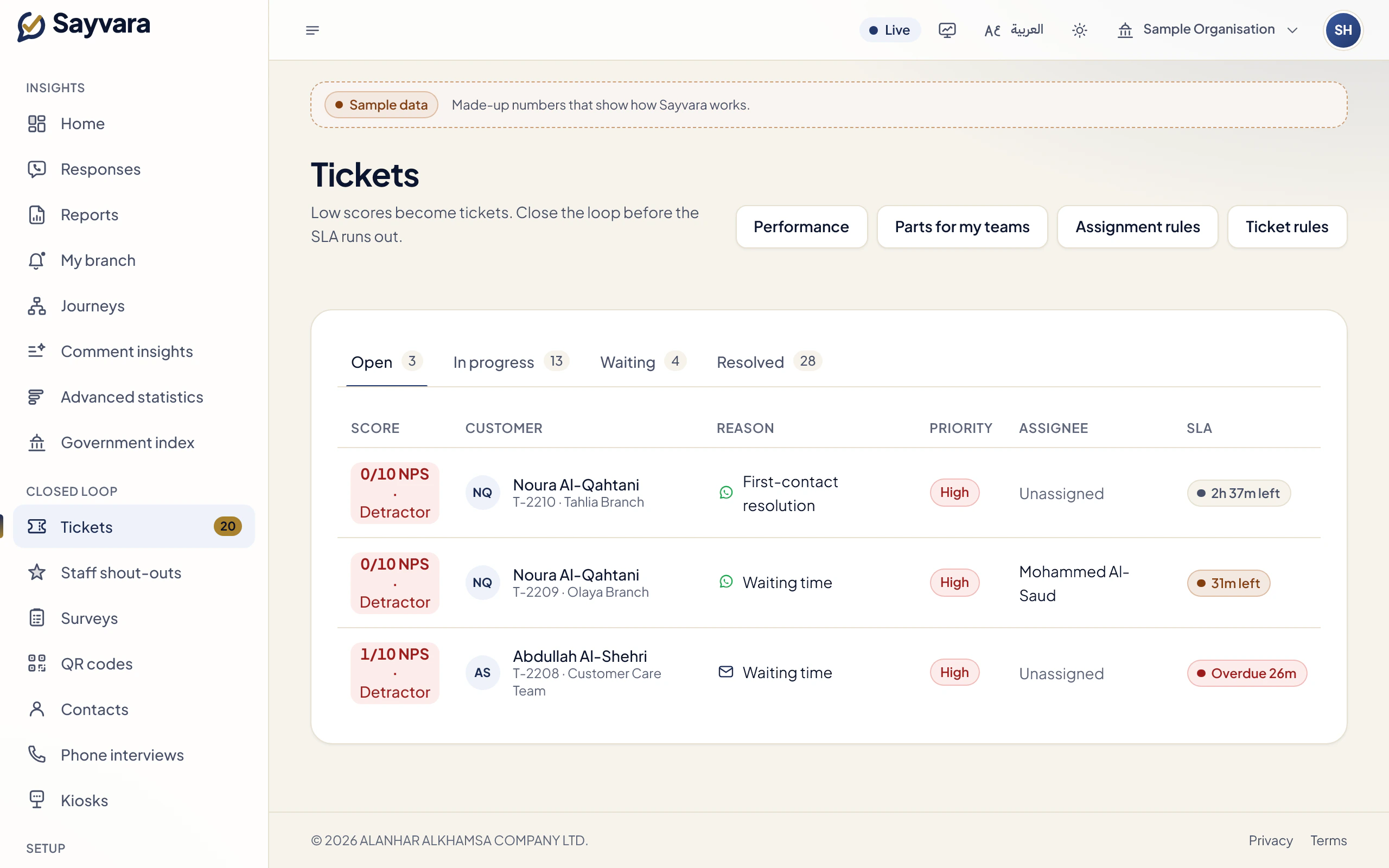
Each ticket has a deadline (SLA). The SLA column shows the time left or how long it is overdue.
Pages in this topic
| Page | What you learn |
|---|---|
| Work a ticket | Read a ticket, add notes, change its status, assignee and root cause, and resolve it |
| Ticket assignment | Share new tickets by turn or by load, and set yourself away |
| Ticket rules | Open tickets on words and phrases, not only low scores |
| Parts for other teams | Split a complaint so other teams do their part |
| My branch on your phone | The frontline manager's phone page |
| Deadlines and performance | SLA states and the agent and team performance report |
Who can do what
| Role | Tickets |
|---|---|
| Owner, admin | Everything, including assignment and ticket rules |
| Manager | Works tickets in their scope, sees the performance report |
| Agent | Works tickets in their scope |
| Analyst | Reads tickets, cannot change them |
| Viewer | Does not see tickets |
Where tickets show up
- Tickets in the side menu, with a badge counting open tickets.
- Home, in Detractors waiting for you: open tickets from low scores, the most overdue first.
- My branch, for managers on the go.
- TV mode, in Unhappy customers waiting.
A good habit
Open Tickets at the start of each shift, sort by the oldest, and reply to each unhappy customer the same day. Customers who hear back quickly often turn into your strongest promoters.
Related pages
Was this page helpful?
Thanks. Need more help? Email support@sayvara.com